
I once visited a traditional unagi restaurant in Tokyo, where grilled freshwater eel is served over freshly cooked rice. What surprised me was not only the eel, but the rice itself.
The rice was glossy and beautifully cooked, with a wonderful texture and just the right firmness. It was so good that it could almost be enjoyed on its own.
Perhaps what made it so memorable was the fact that rice is something we eat almost every day. When something so familiar can still surprise you with how delicious it is, you realize just how much difference careful preparation can make.
Good rice brings out the best in the dishes served alongside it. That is why learning to cook rice well is one of the foundations of Japanese cuisine.
Cooking Rice Is a Foundation of Japanese Cooking
At our cooking school, we repeatedly return to the fundamentals: how to cook rice, how to prepare dashi, and how to measure ingredients properly. Among these basics, one of the first things I want students to learn is how to wash rice.
At the school, we teach students to cook rice in a pot. We often use a traditional Japanese “hagama,” but an ordinary pot works just as well. Cooking rice this way allows students to observe how the rice changes as it cooks and to understand the process itself.
My grandfather, Toshio Yanagihara, used to say that cooking rice is the foundation of “nitaki”—the Japanese practice of simmering and cooking foods with liquid. We continue to follow his teaching today, encouraging students to observe what happens inside the pot as the rice cooks.
Some traditional unagi restaurants even have a person whose dedicated job is to cook the rice. They carefully select the rice itself and pay close attention to how it is prepared. It is a reminder of just how important rice can be to the overall quality of a meal.
Look Beyond the Cultivar
For generations, Japan has worked to develop rice cultivars with better quality and higher yields. Koshihikari, known for the texture many people enjoy, is one of the best-known examples, and many other cultivars have been developed across the country.
In the past, much of this work focused on developing rice that could produce good yields even in colder regions. Today, as the climate grows warmer, increasing attention is being given to cultivars that can withstand higher temperatures.
There are many excellent rice cultivars, but the cultivar alone does not determine how good the rice will taste. The quality and condition of the rice itself matter just as much.
You can learn a lot about rice simply by washing it. Some rice grains break easily during washing or release a large amount of powdery residue. Rice in good condition, on the other hand, tends to hold its shape well, with fewer cracked grains.
Of course, when buying rice in a bag, it is impossible to inspect every grain. This is why choosing rice from a producer, shop, or brand you trust is also important.
How you store the rice after buying it matters as well. As rice sits over time and becomes dry, the grains can develop cracks. Store rice in a container that helps prevent it from drying out, and try not to keep it for too long.
Paying attention to each grain as you handle rice every day is one of the first steps toward cooking truly delicious rice.
Why Do We “Polish” Rice Rather Than Simply Wash It?
In Japanese, we do not usually say that we “wash” rice. We use the verb “togu,” which literally carries the sense of polishing or rubbing.
Modern milling techniques have improved greatly, so much less rice bran remains on the grains than in the past. This means there is no need to wash rice as vigorously as people once did. Even so, I believe that “togu” remains an important step.
The bran that remains after milling helps protect the rice from drying out. But at home, we cannot always cook rice immediately after it has been milled. Over time, the bran can oxidize, so washing the rice before cooking removes what is no longer needed and helps the rice cook to a clean, beautiful white.
Wash the Rice Gently
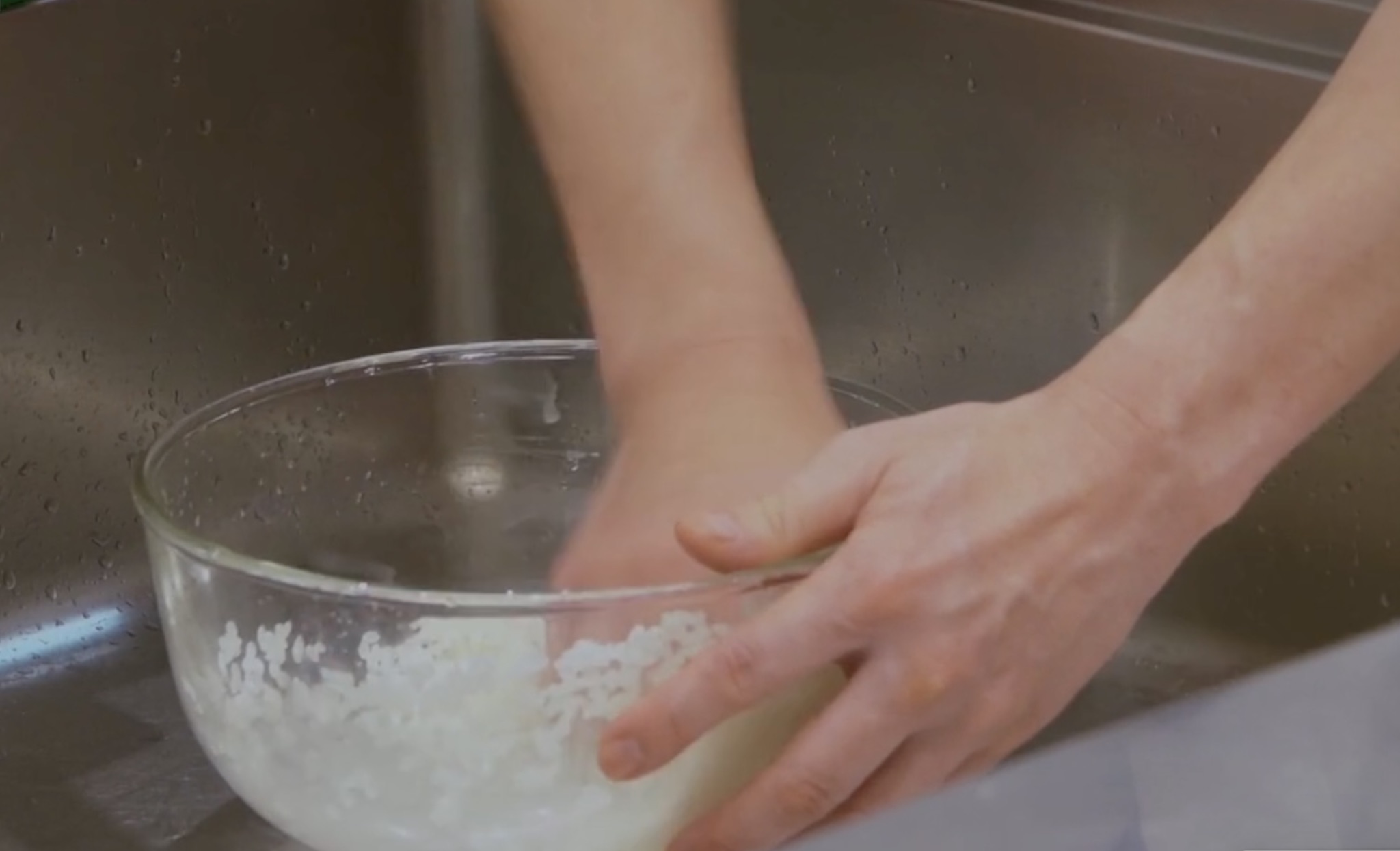
Begin by quickly rinsing the rice with water, then drain it. Place the drained rice in a relatively deep bowl. A deeper bowl makes it easier for the grains to gently rub against one another than a wide, shallow one.
The important thing is not to use too much force. Washing too vigorously can cause the grains to crack, so pay attention to their condition and work gently.
Once the rice has been washed, drain it in a colander. If you are going to cook it soon, soak it in water before cooking.
For ordinary white rice, a useful guideline is to start with about 20 percent more water than the volume of rice. For example, if you have 400 ml of rice, use approximately 480 ml of water. The rice absorbs that additional water as it soaks, so by the time you begin cooking, the remaining water and rice are approximately equal in volume. As the rice absorbs the water, the grains turn white.
Cooking good rice is one of the foundations of Japanese cuisine. Start by taking a little more time with this ingredient and paying attention to the rice in front of you.
And what happens after the rice has been washed? In a future article on Kinsaryu Library, we will look more closely at how to cook rice—including how to control the heat and how to recognize when the rice is perfectly cooked.