
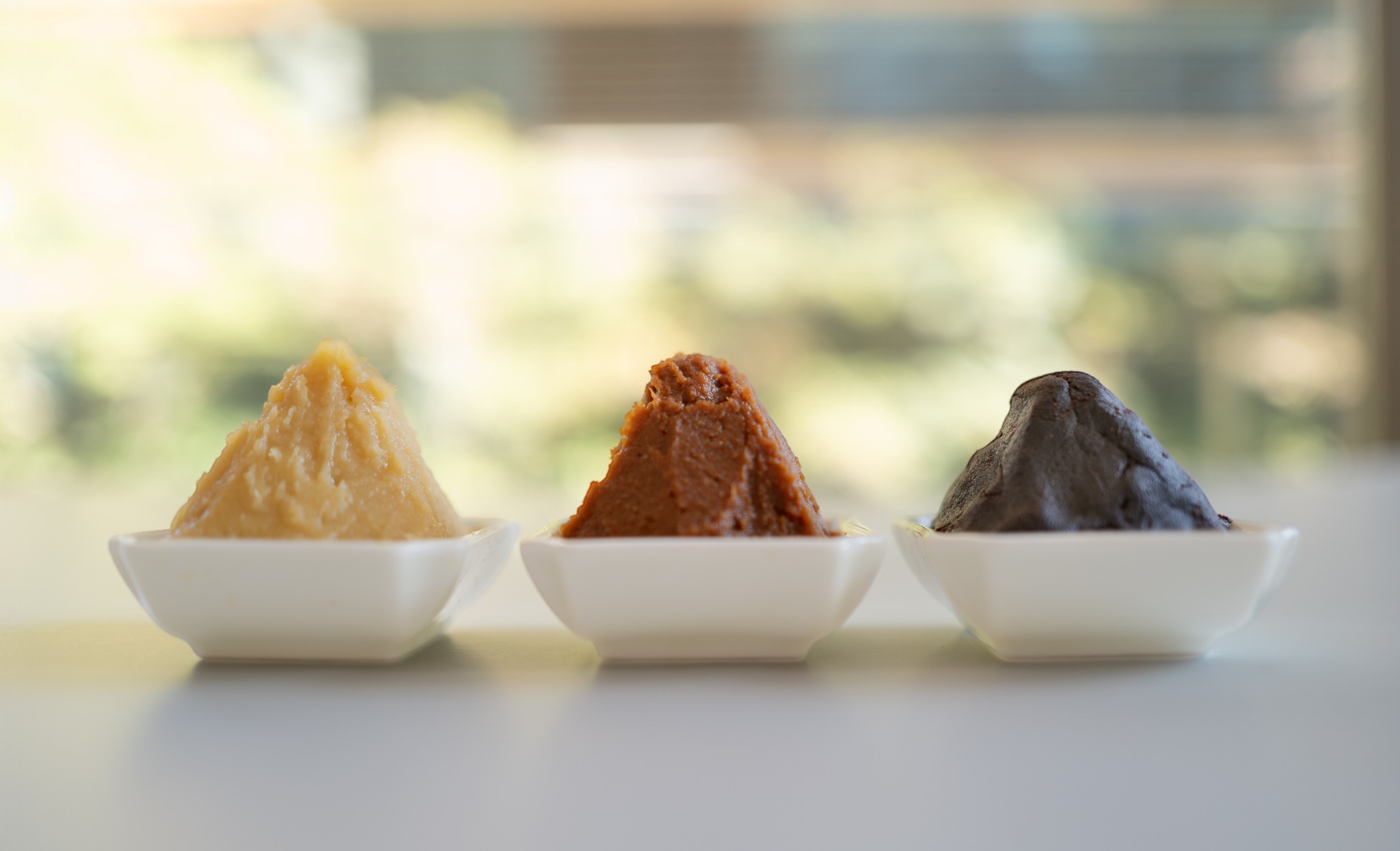
If you think miso is just “that paste for miso soup,” you’re not alone.
But once you start learning about it, miso opens up a surprisingly deep and fascinating world.
In this article, we’ll explore how diverse miso really is, why it tastes so different from region to region, and how you can use it more creatively at home—not just in soup, but in everyday dishes.
Why Are There So Many Kinds of Miso?
In Japan, miso is deeply connected to local climate, ingredients, and food culture.
That’s why you’ll find miso named after places, such as Sendai miso, Shinshu miso, Hatcho miso, or Saikyo (white) miso. These place-named miso varieties vary widely in color and flavor, reflecting the diversity of regional food cultures and customs across Japan.
Unlike soy sauce or vinegar, miso is so diverse that there had been actually no official national standard for it until 2022. Each region has developed its own style over time, and that variety is part of miso’s charm.
Key Factors That Shape Miso
Miso is made primarily from soybeans, salt, and a fermentation starter called **”**koji.” While rice koji is the most common, barley and soybean koji are also used, creating different regional styles of miso.
Although there are countless regional and household variations, the character of miso is mainly shaped by these factors:
- The type of koji (rice, barley, or soybean)
- The ratio of koji to soybeans
- The amount of salt used
- The length of the fermentation period
When a larger amount of koji is used, the miso becomes lighter in color and naturally sweeter. This is how mild, pale varieties such as white miso are made.
Using less koji—or none at all—results in darker, more robust miso, such as Hatcho miso, which is made entirely from soybeans.
A miso made with roughly equal amounts of koji and soybeans produces a well-balanced flavor, and this type is most commonly used in Japan for everyday miso soup.
A Quick Tour of Popular Miso Types
- Standard miso (like Shinshu miso)Well-balanced, fermented for about a year, and perfect for daily miso soup.
- Sendai misoMade with more soybeans and less koji. It has a deeper color, a bold aroma, and a slightly higher salt content.
- Hatcho misoMade almost entirely from soybeans and fermented for up to three years.It looks very dark, but it’s not overly salty—its strength is deep, concentrated umami.
- White miso (Saikyo miso)Sweet, mild, and lightly fermented. Because it’s low in salt, it doesn’t keep for long, but its gentle flavor is perfect for delicate dishes.
These are just a few examples, but they give a good sense of how much miso can vary in both saltiness and flavor. Because of that range, there are many different ways to enjoy it.
| Miso Type | Koji Ratio* | Fermentation Period | Characteristics |
|---|---|---|---|
| White Miso | 0 | About 3 weeks | Sweet, light-colored, short shelf life |
| Shinshu Miso | 50–70% | About 1 year | Well-balanced, commonly used daily |
| Sendai Miso | 100% | About 1 year | Fragrant, rich and full-bodied |
| Hatcho Miso | 200% | About 2 years | Dark color, very strong umami |
※The “koji ratio” is a traditional way of expressing how much koji is used compared to soybeans, and it greatly influences sweetness, color, and flavor.
How Salty Should Miso Soup Be?
People often wonder how much miso to use when making miso soup. As a rough guideline, a well-balanced bowl of miso soup usually has a salt level of around 0.9%. For a saltier miso like Sendai miso, using about 8–10% miso by weight compared to the amount of broth works well. With a sweeter, milder white miso, you can use closer to 20%.
That said, the best approach is simply to taste as you go. Since each type of miso has its own balance of sweetness and saltiness, adjusting the amount little by little will help you find the flavor that feels just right.
Enjoying Miso Beyond Miso Soup
With so many different types available, miso can be enjoyed in many ways beyond miso soup. There are countless dishes that use miso, but one of my personal favorites is ”nerimiso,” a thick, glossy, sweet miso paste.
Nerimiso is often used for dishes like ”dengaku,” where it’s served on grilled eggplant or “konnyaku.” Here’s a simple version you can try at home.
In a small saucepan, combine 50 g of Sendai miso, 45 g of sugar, and 1 tablespoon of sake, and mix well before turning on the heat. Once everything is blended, cook over high heat, stirring constantly. As the mixture heats up, it will become shiny and start to bubble. At that point, add a little more sake to adjust the consistency, and it’s ready. This is the basic nerimiso. If you replace the sake with vinegar, it becomes ”sumiso,” a tangy vinegar-miso sauce.
Simply spooned over hot, freshly cooked rice, nerimiso is deeply satisfying. It also pairs nicely with sautéed eggplant, or served alongside raw cucumber as a small appetizer. Stored in the refrigerator, it keeps well and can be enjoyed over time.
A Final Note on Miso
Miso is something many of us use every day without really thinking about it, yet it comes in an amazing variety of styles and flavors. The way miso changes from one region to another mirrors Japan’s different climates and landscapes, which is part of what makes it so interesting. Sampling different kinds of miso and finding the one you love most can be a fun journey in itself!