
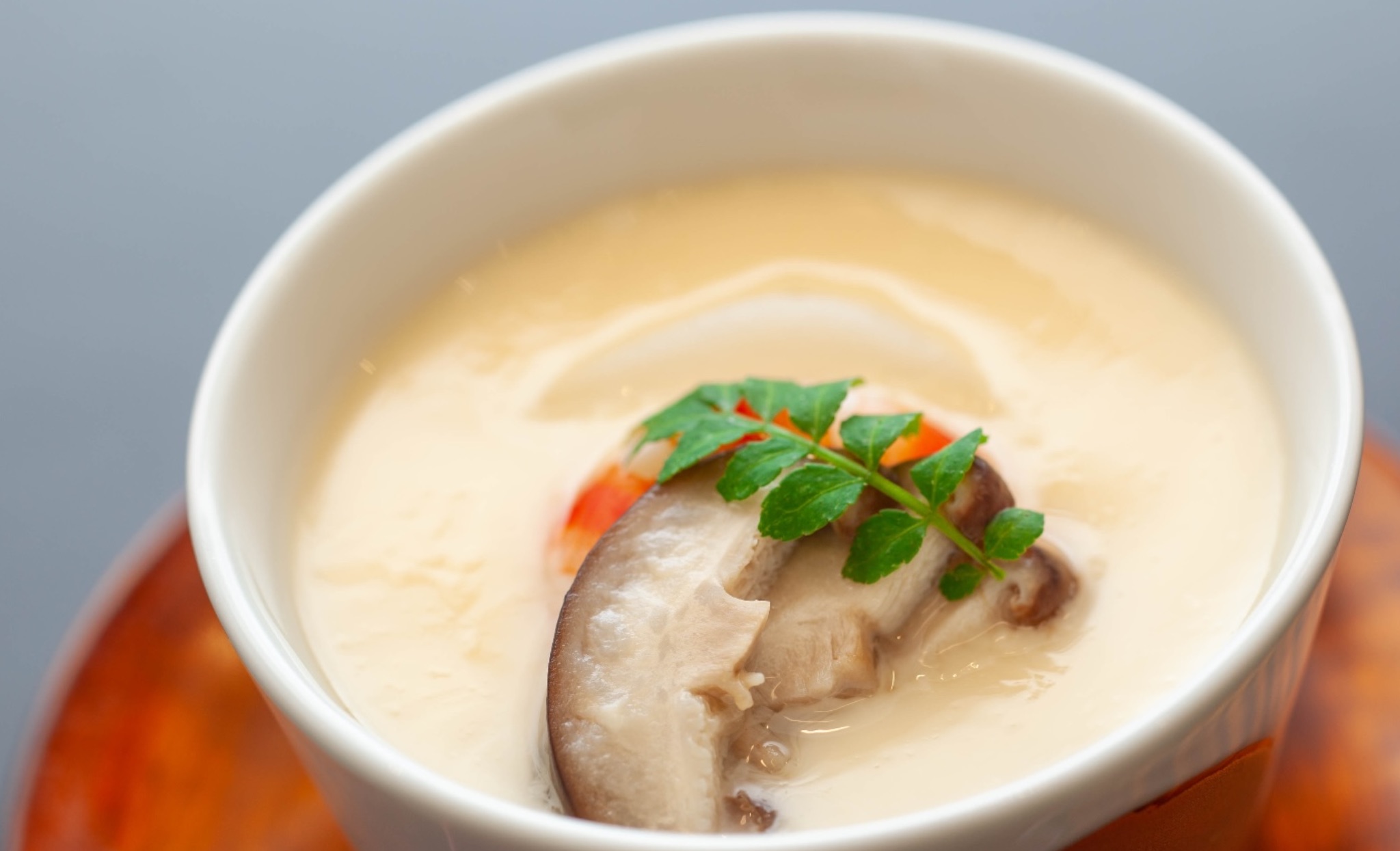
Chawanmushi is a delicate steamed egg custard.
Despite the name “custard,” chawanmushi isn’t sweet. Think of it as a silky, savory egg dish flavored with dashi, salt, and light soy sauce. Its silky texture gently melts in your mouth, while the savory flavor of dashi slowly spreads across the palate—that’s its unique charm.
When the weather turns cold, a warm bowl of ”chawanmushi” tastes especially comforting.
Today it’s a familiar dish in Japan, but not so long ago it was considered a special treat—something served on festive occasions.
The secret to its flavor is actually quite simple: good dashi and careful steaming.
Once you understand just a few key points, chawanmushi can become a reliable, impressive dish to make at home. So let’s take a closer look at this classic of Japanese cuisine.
What Makes Chawanmushi So Special?
Because it contains eggs, chawanmushi was once considered a luxury dish. During the Edo period (1603–1868), eggs were extremely expensive—one egg could cost the equivalent of several dollars today. A dish that used multiple eggs was therefore quite extravagant.
After the 1950s, however, advances in poultry farming made eggs much more affordable. As a result, chawanmushi gradually became a beloved everyday dish enjoyed by many people across Japan.
Interestingly, in traditional Japanese cooking, chawanmushi is classified in the same category as a clear soup (”osuimono”). That means the flavor of the dashi—a savory broth usually made from kelp and dried bonito flakes—is especially important.
If possible, try using freshly made dashi when you cook. The aroma of the broth, gently sealed inside the egg custard, becomes wonderfully fragrant. One important tip: never mix eggs into very hot dashi. Fresh dashi is hot enough to start cooking the eggs immediately, which can ruin the texture. Let the dashi cool to about body temperature before combining it with the eggs.
A Common Mistake: Bubbles in the Custard
One of the most common problems when making chawanmushi is something called ”su”—tiny bubbles or holes that form inside the custard. In Japanese, this is written with a character that also appears in the word for osteoporosis, and it refers to a porous, sponge-like texture.
When these bubbles form, the custard becomes firm and grainy instead of smooth and silky.
This happens when the temperature inside the steamer gets too high. If it rises above 100°C (212°F), the egg mixture starts to boil, creating bubbles that become trapped as it solidifies.
The Right Temperature for Perfect Texture
The ideal steaming temperature for chawanmushi is about 80–90°C (176–194°F).
Keeping the temperature in this range gives you that signature silky texture.
In professional kitchens, chefs often use a technique called ”kiributa,” or “vented lid.” This means leaving a small gap between the lid and the steamer so excess heat can escape. At home, you can easily recreate this by placing a pair of chopsticks between the pot and the lid, then covering the lid with a cloth. This allows steam to escape gently and prevents water droplets from falling onto the custard.
Even with this method, though, the heat level still matters. Temperature can be hard to judge by feel, so it helps to watch the steam:
- Strong, forceful steam → heat is too high
- Gentle, slow, mist-like steam → just right
Aim for steam that rises softly, like the steam from a hot spring. If you’re unsure, using a thermometer to keep the steamer between 80 and 90°C is a great way to start. Cooking is both art and science—if you control the temperature, the results will follow.
Many modern kitchens use induction cooktops (IH) instead of gas. Because they maintain a steady heat, they’re actually very well suited to making chawanmushi.
A Japanese Comfort Food
I once taught chawanmushi in Brazil to members of the Japanese-Brazilian community. I still remember the expressions on their faces when they tasted it.
“This reminds me of home,” they said quietly.
Moments like that make me realize how deeply this dish is rooted in Japanese food culture. For many people, chawanmushi is more than just a recipe—it’s a taste of comfort and memory.
With just a little attention to dashi and temperature, you can make beautifully smooth chawanmushi at home.
Give it a try, and enjoy the gentle, comforting flavor of this classic Japanese dish.