
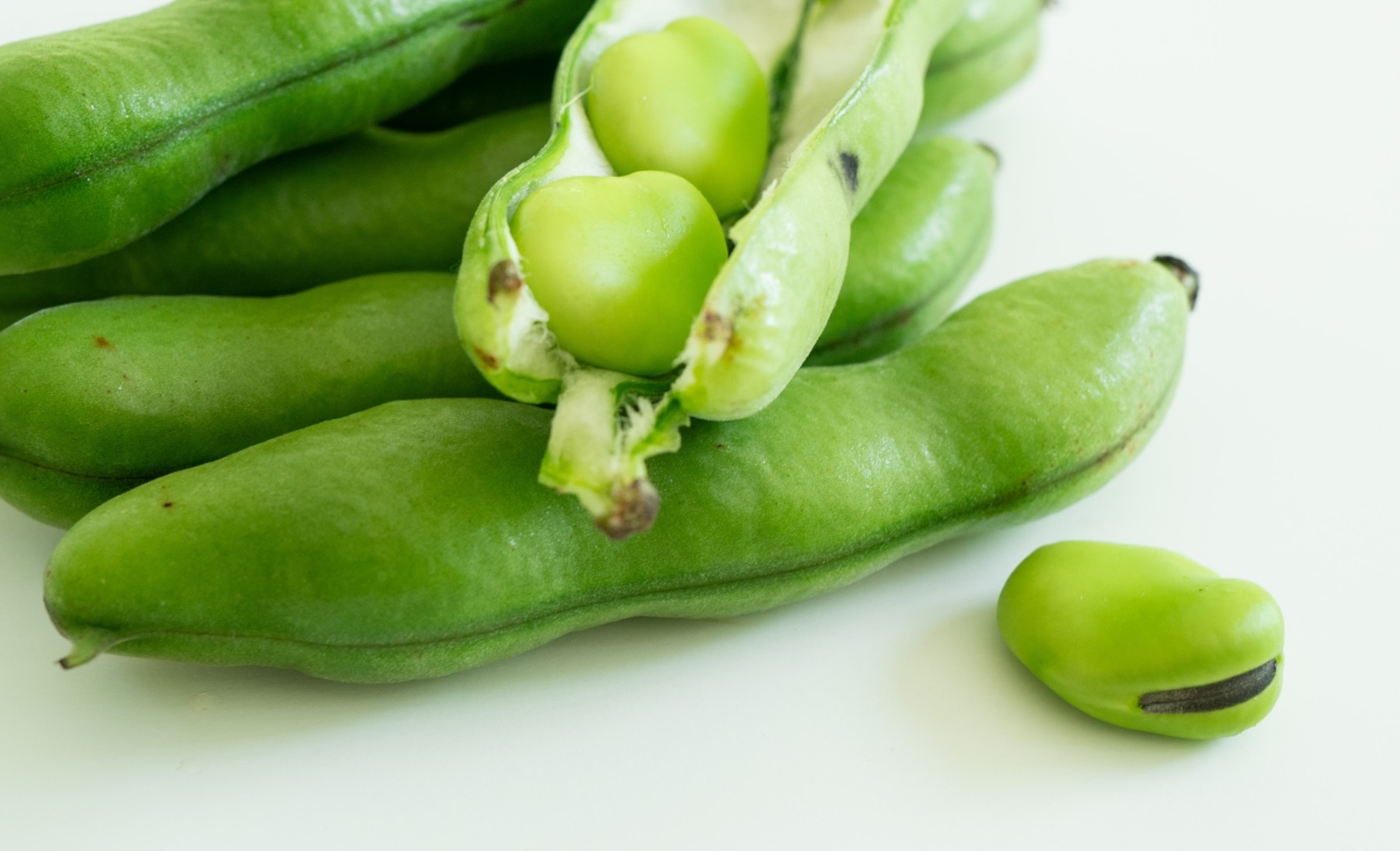
Broad beans (fava beans in the United States), known as soramame in Japanese, are one of Japan’s most beloved seasonal vegetables, signaling the arrival of spring and early summer.
Interestingly, soramame can be written with two different sets of Chinese characters: 蚕豆 and 空豆. The first, 蚕豆(“silkworm bean”), comes from the resemblance of the pod to a silkworm. When the pod is opened, the beans appear to be resting inside a soft, fluffy lining, much like silkworms nestled in silk. The second, 空豆 (“sky bean”), refers to the way the young pods grow upright, pointing toward the sky.
As the beans mature, the pods become larger and gradually droop until they hang almost parallel to the ground. This is a sign that they are ready for harvest. These names reflect how closely people in the past observed plants and incorporated their characteristics into everyday language.
Today, broad beans are cultivated throughout Japan, from Hokkaido in the north to Kagoshima in the south. Their peak season, however, is from spring to early summer. In the Kanto region, they are traditionally said to be at their best around the time of the Sanja Matsuri. Early-season broad beans are prized for their bright green color and fresh, juicy flavor. As the season progresses, the beans become fuller and develop a richer, more floury texture.
The most common way to prepare broad beans is simply to boil them in salted water. Later in the season, when the beans have fully matured, another traditional preparation known as ”yoroi-ni” (“armor-style simmered broad beans”) is especially enjoyable. In this dish, the beans are simmered while still enclosed in their outer skins, which resemble protective armor. Seasonal broad beans are delicious on their own, but they’re especially hard to resist alongside a cold glass of beer.