
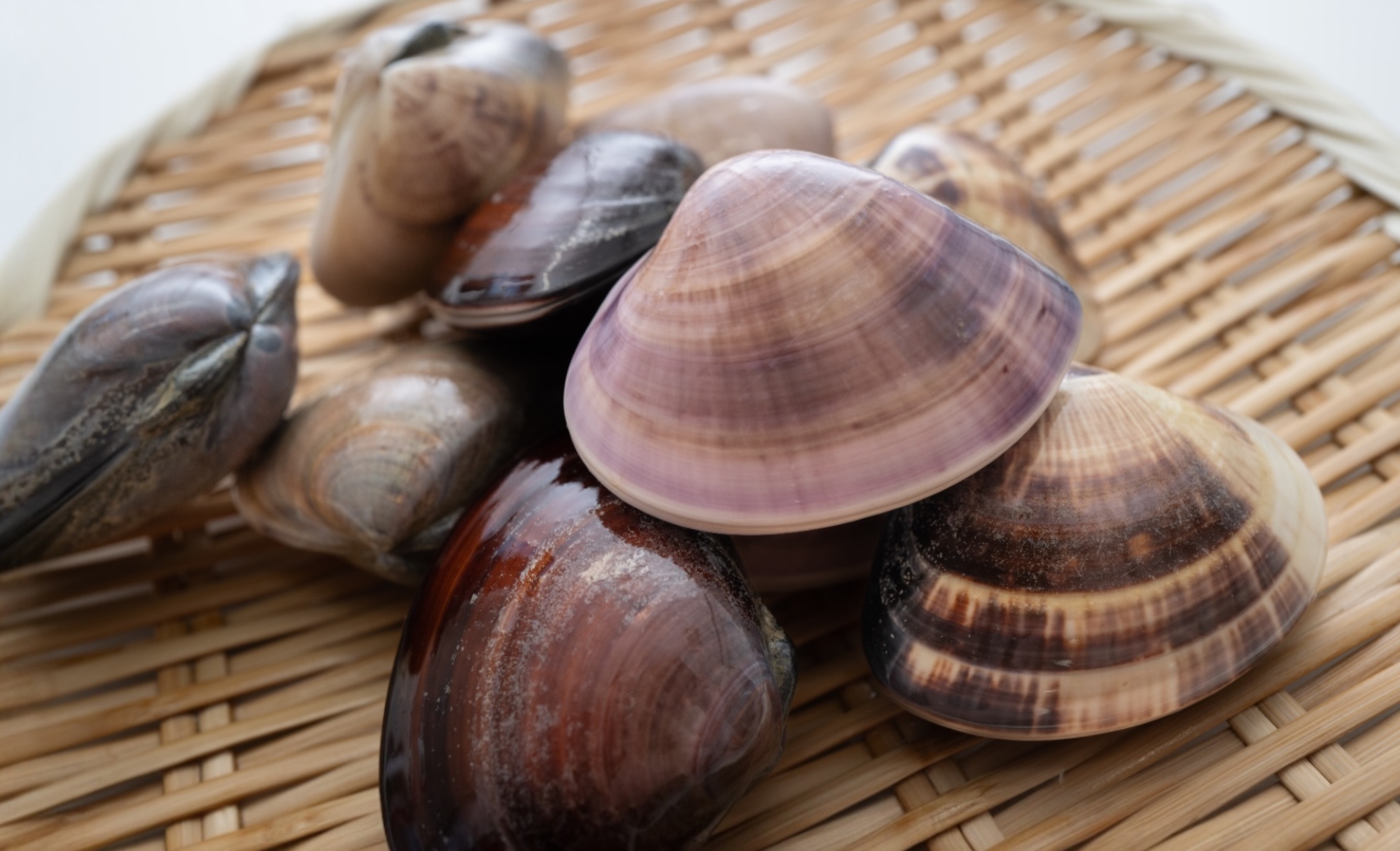
Clams are one of the most familiar and representative bivalves in Japanese cuisine. It is said that the word ”hamaguri” comes from “hama” (beach) and “kuri” (chestnut), as their shape and color resemble chestnuts.
They thrive in shallow, sandy areas of calm inner bays. Since the Edo period, clams from Kuwana in Mie Prefecture and those harvested from Edo Bay have been especially well known. Today, Kujukuri in Chiba is also considered a major producing area.
Like all bivalves, clams have two shells connected by a strong ligament and kept tightly closed by two adductor muscles. To open them, a special tool called a ”hamamuki” is used to cut these muscles. Back when Tsukiji was still the main fish market, every shellfish shop had the women in the back who were incredibly fast at shucking clams, known as ”kaimuki no anesan”. Watching them work was amazing—they could shuck clams in the blink of an eye. If the siphon or the mantle (the thin membrane around the meat) was damaged, the clam would shrink when simmered and lose its beautiful shape. The most skilled shuckers were so respected that customers would even request them by name.
Selling shellfish already removed from their shells is a tradition that goes back to the Edo period. In Edo, clams were commonly sold this way. In fact, ”Fukagawa-meshi,” a classic local dish that still exists today, wouldn’t have been possible without this shucking culture. Ukiyo-e prints also show a traditional way of enjoying clams in Kuwana: ”yaki-hamaguri,” where clams are grilled in their shells over burning pinecones. The real pleasure was savoring the rich juices sealed inside.
Because each pair of clam shells fits together perfectly, clams gave rise to the shell-matching game ”kai-awase” and came to symbolize harmony between husband and wife. That’s why clams are often used in celebratory dishes.
When cooked in their shells, clams are often made into a simple clear soup called ”ushio-jiru,” or grilled as ”yaki-hamaguri.” If you cut the ligament before grilling, the shell won’t pop open, which keeps the clam from tipping over and helps preserve all those flavorful juices. Shucked clams are great in hot pots or ”kamameshi” rice (pot-cooked rice), and they also work well for ”shigure-ni” (simmered clams in sweet soy sauce) or as a sushi topping.
In February, students in our second-year course make clam ”ushio-jiru” as part of their lessons. It’s a dish that feels just right for ”Jōmi no Sekku,” the Girls’ Festival in March.